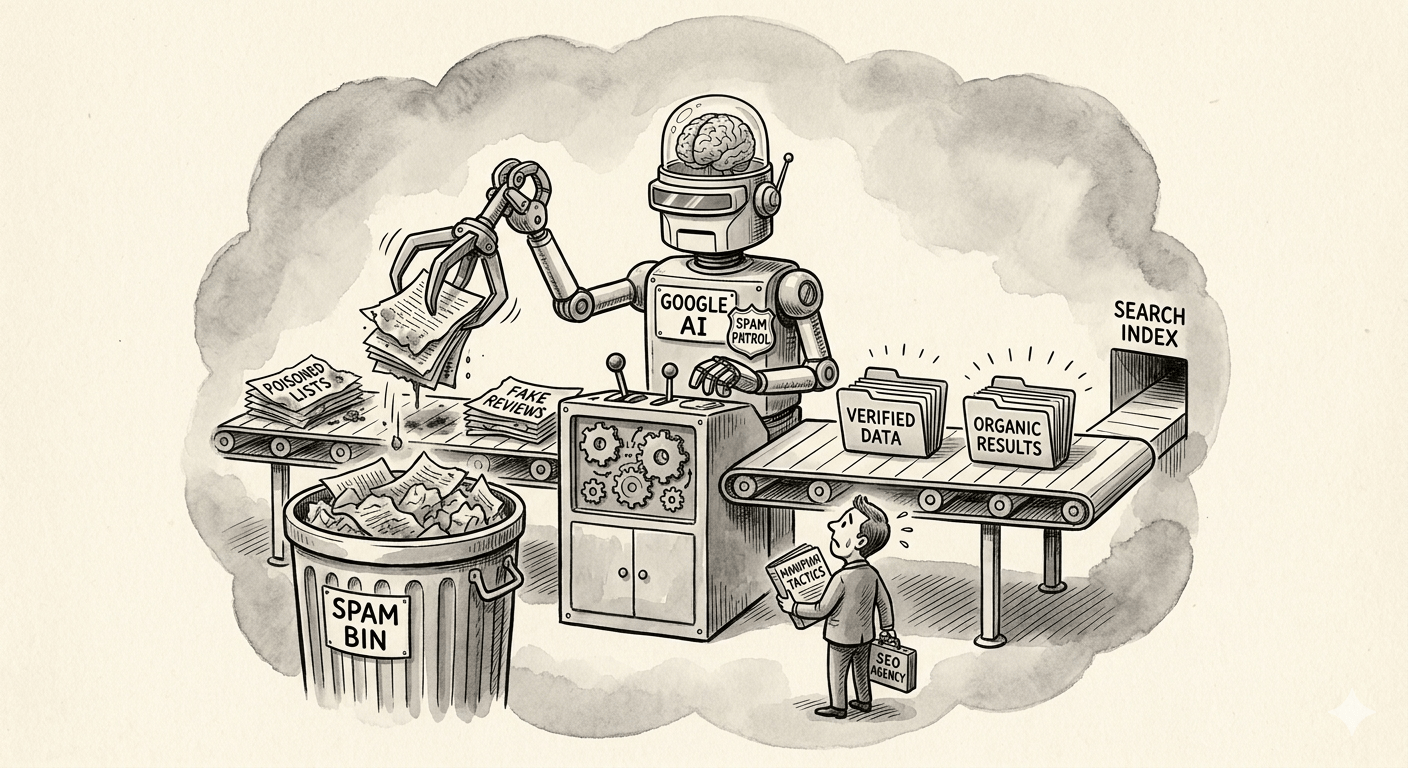
Google quietly updated its Search spam policy on 15 May. Search Engine Land caught the change first; Gizmodo and Outrank followed the same day. The addition is eleven words: spam now also includes "attempting to manipulate generative AI responses in Google Search." Coverage of the update names the tactics explicitly: biased listicles and "recommendation poisoning".
What recommendation poisoning is
The pattern is well established. An agency buys a network of low-traffic websites, generates plausible-looking listicles ("Top 10 Late-Night Eats in Leeds", "Best Sunday Roast in Bristol 2026") and seeds the client into them. Bing indexes the network, ChatGPT Search reads Bing, Google AI Overviews and AI Mode read their own crawl, and the model picks up the listicle as a "source". The diner asks for a recommendation; the planted restaurant appears.
It works, briefly. It is also exactly the thing Google's update is built to target.
The other branded tactic in the same paragraph is "biased listicles" — paid-for round-ups that misrepresent independent opinion. Google's policy now treats both as ranking-removable spam.
AI Overviews and AI Mode are both in scope
This was not an obvious extension. AI Overviews and AI Mode are not classical Search results — their citations are not ten blue links, and until last Friday it was an open question whether Google's spam rules applied to the model's recommendations at all.
They do now.
Penalties include lower ranking, removal from results, and detection by "automated systems and human reviewers". The enforcement layer is the existing one. The surface it now reaches is new.
The cottage industry was real
A cottage industry has grown around getting restaurants into AI answers since ChatGPT added location in March. Some of it is honest — schema audits, review-velocity work, structured menu pages. Some of it has been the listicle racket described above, sold to chains and independents alike with no disclosure of where the placements run.
Chains that bought the cleanest packages will probably absorb the loss. Restaurants that paid for "guaranteed ChatGPT placements" are dealing with an agency that has little to show for their money.
What still works
The route to the assistants that does not violate the spam policy is the slow one: a website the model can read, a menu marked up so the dishes are objects rather than prose, a Google Business Profile that matches the page, reviews that match the food. Nothing in last week's update changes that. If anything, the policy makes this the only route with a future.
Menu software that outputs Schema.org data handles the markup as a by-product of you updating the menu. The model finds the restaurant because the restaurant is legible, not because someone bought it a placement in a fake top-ten.
The next round of enforcement is the interesting one
Google has named the tactic. It has not yet published a wave of penalties. The first enforcement actions will tell SEOs and restaurant operators which of the GEO agencies were running borderline campaigns and which were running ones Google considers spam.
The agencies will adapt; they always do. Some will pivot to legitimate structured-data work. Some will rebrand the same listicle networks under a new label and try again.
The restaurants paying them should pay attention this week.