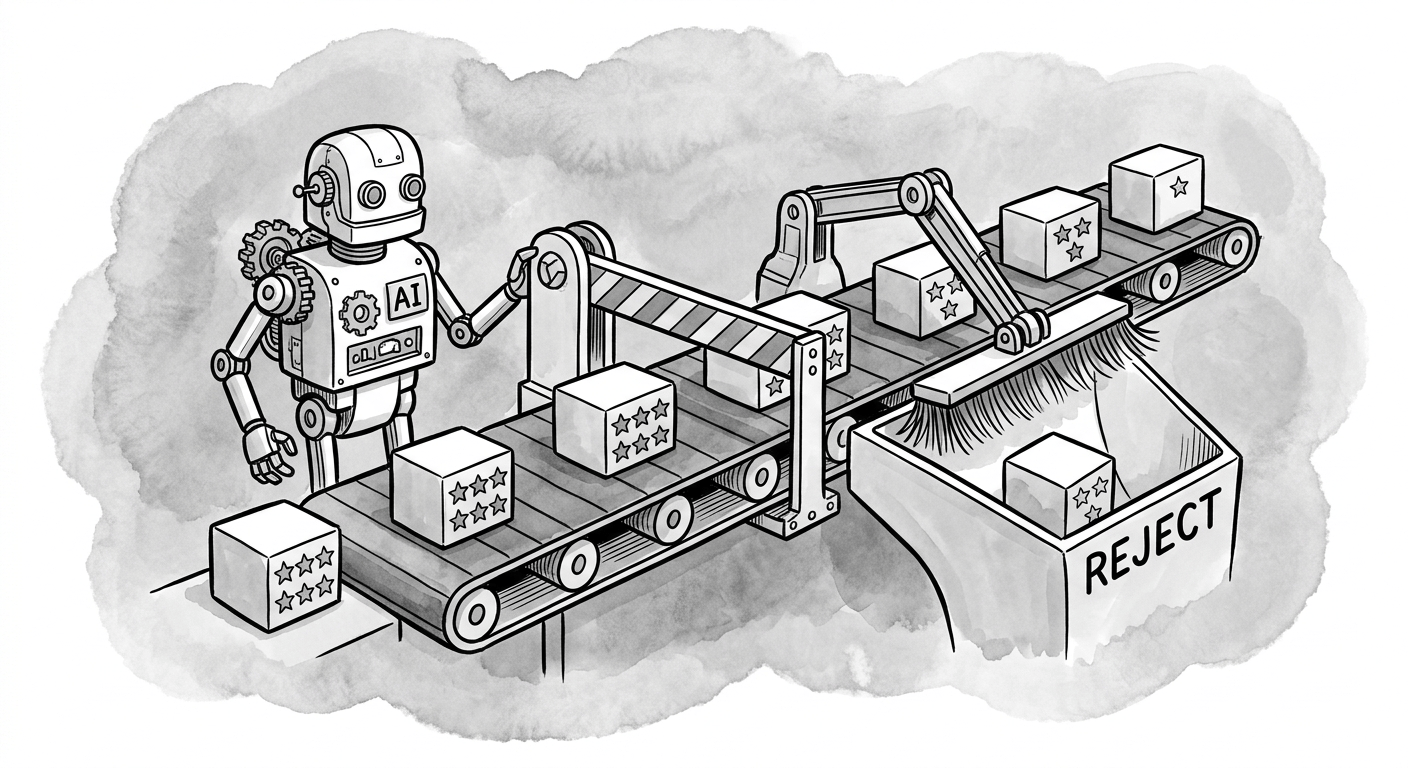
Uberall published a benchmark on 7 May finding that 83% of QSR locations are invisible to AI search. The reason isn't poor listings or missing hours. Each assistant — ChatGPT, Perplexity, Gemini — applies a star-rating floor, and most locations fall below it before the model reads a single detail about what they serve.
The cutoffs are real and they aren't the same
Uberall's 2026 quick-service benchmark measured how ChatGPT, Perplexity and Gemini respond to restaurant-discovery prompts run against its global QSR customer base. The headline number — 83% of QSR locations invisible to AI search — is striking enough on its own. The more useful finding is what each assistant uses as a hard floor: a star-rating threshold below which a restaurant is unlikely to appear in any answer.
The thresholds sit between 3.9 and 4.3. Each platform's effective cutoff lands in a slightly different place. A burger restaurant on 4.0 might clear one assistant's bar and miss another's. A coffee shop on 3.8 will struggle to appear in any of the three for the queries Uberall ran.
That's a hard cutoff, not a soft ranking signal.
What invisibility looks like in practice
The Uberall figure is for QSRs — chicken, burger, pizza, Mexican, coffee, sandwich, breakfast, Asian fusion — and the report names Burger King BELUX as one of the brands tested. The methodology runs each location's current Google rating against the kind of prompts a diner would actually type.
If a location's reviews sit half a star below an assistant's cutoff, no amount of menu cleverness pulls it back into the answer. The model never reads your menu. It never sees your dietary tags or your gluten-free section. The query terminates before your address is loaded.
Reviews are the gating signal. Schema on the menu decides whether you show up usefully once the gate is cleared.
Why the gate exists
Assistants face the same problem as a human picking a lunch spot in an unfamiliar town. They have to bias against a wrong recommendation. A bad steak on someone's evening out is worse, in product terms, than failing to show one of three plausible alternatives.
The cutoff is how each model trades off recall against confidence. The model that picks the highest cutoff produces the cleanest answers, and the broadest invisibility.
For diners, that's mostly fine. For operators with locations sitting under the cutoff, it isn't.
The cleanup most chains haven't done
The report walks through what Uberall calls Location Performance Optimization across four pillars: visibility, reputation, engagement, conversion. The reputation pillar is the one that determines whether a location clears the cutoff at all. The visibility pillar — accurate listings, Schema.org markup, hours that match across Google Business Profile and the venue's own site — is what pulls a location into the answer once the cutoff is cleared.
Most multi-location chains have not finished this work. The Uberall data shows large estates with real review-management gaps and inconsistent local listings. Each mismatched address is a piece of friction the model can use to drop you from the answer.
What this means for the rest of the high street
Independent restaurants were not the focus of the Uberall study, but the same logic applies. A neighbourhood place on 4.5 stars and a properly marked-up menu is a candidate for whichever assistant a diner happens to ask. A neighbourhood place on 4.5 stars with the menu only on Instagram is a candidate the assistant cannot describe past the name on the door.
Reviews decide whether the assistant talks about you. Schema decides whether what it says about you is accurate.
The Uberall report is a press release written by a vendor of the fix it's selling. The numbers in it are still useful, because someone has finally measured the gap and put star thresholds against it.
GMMO sits on the menu side of this: Schema.org markup as a side-effect of keeping a menu current. It does not move a location's star rating. It determines what an assistant can describe once the rating has cleared the gate.
Two separate problems, then: one is a review-management gap that only time and customers can close; the other is a structured-data gap that can be fixed this week. The Uberall data suggests most locations haven't finished either.