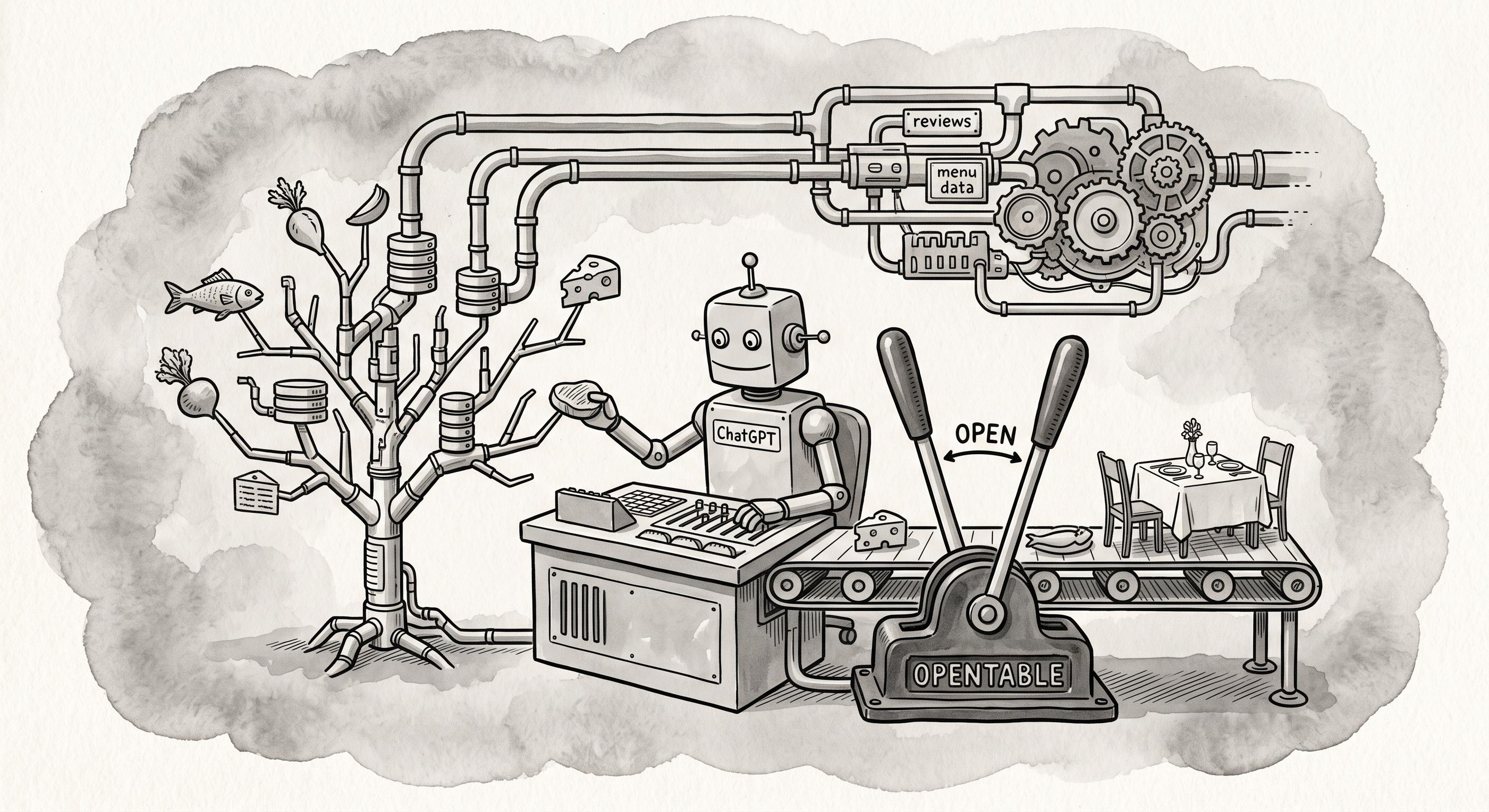
OpenAI added table booking to ChatGPT on 10 August. A diner can now ask for a restaurant, narrow it by time, party size and cuisine inside the conversation, and confirm the reservation without leaving the chat — through OpenTable, Resy or Yelp, depending on where the restaurant takes bookings. On Yelp, the same flow also joins a waitlist.
Only OpenTable reaches Britain
The three platforms do not cover the same map. OpenAI's own note is exact about it: reservations work globally through OpenTable, in the United States through Resy, and in the US and Canada through Yelp. For a restaurant in Leeds or Cardiff, one clause in that sentence does all the work. OpenTable is the only one of the three that takes bookings in the UK, which makes it the only one that can seat a British diner from inside ChatGPT this week.
Yelp's share of the launch is the largest by volume. Chad Richard, its senior vice president of business and corporate development, put the reach at thousands of restaurants across the US and Canada, booked through Yelp Guest Manager. None of that lands in Bristol. A UK operator reading the announcement has one thing to check: whether they are on OpenTable at all, and whether what OpenTable holds about them is current.
The reservation system became a discovery choice
Choosing a booking platform used to be a question about cover fees, table management and the cut taken on a no-show. It still is. It is now also a question about which assistant can complete a booking on the restaurant's behalf. A venue on OpenTable can be reserved inside ChatGPT. A venue that takes bookings by phone, or through a form on its own site, never appears at the point in the answer where the table actually gets booked.
This is the pattern from earlier in the year, assembled differently. Google wired eight reservation platforms into its UK AI Mode booking in April. American Express put Resy inside Claude in the United States around the same time. OpenAI has now folded three platforms into ChatGPT in a single announcement. There is still no shared registry a restaurant can join to appear everywhere; each assistant books through the systems it has signed, and being off one of those systems is the cheapest way to be missing from the surface.
The booking is the last step, not the first
A reservation is what happens once the diner has already chosen. Before that comes the question no booking integration answers: whether the kitchen does a dairy-free pudding, whether someone with a nut allergy can eat there safely, whether the early set menu is still running. A review says the room was warm and the pasta good; it does not say what tonight's specials leave out. That answer sits in the structured menu data on the restaurant's own pages, and the reservation rail does not carry it.
So three separate things now describe a restaurant inside ChatGPT: the reviews Yelp licensed to OpenAI in late July, the menu data the restaurant marks up itself, and, as of this week, the booking. The first two are what make ChatGPT recommend a place at all. The booking is the new part — the power to seat a diner there without a website visit. That power is not evenly spread. It reaches only restaurants on a reservation system ChatGPT has signed, and in Britain, for now, that means OpenTable, or nothing.